25 Strangest Prehistoric Creatures To Roam The Earth
Life on Earth has been running its wild evolutionary experiment for roughly 3.8 billion years — and the results have been spectacular, terrifying, and occasionally downright absurd. Long before humans arrived to catalog and name things, the planet hosted creatures so bizarre they seem pulled from a fever dream. We’re talking about animals with circular saw-blade mouths, five eyes, bat-wings made of membrane, and claws the length of your arm.
The 25 strangest prehistoric creatures on this list span from the Cambrian explosion — when complex animal life first erupted in spectacular diversity — all the way through the Ice Age megafauna that vanished just thousands of years ago. Some of these animals are famous among paleontology enthusiasts. Others remain so obscure that even scientists debated their basic classification for decades. All of them share one thing: they make you rethink everything you thought you knew about what an “animal” could look like.
Whether you’re a lifelong fossil fan or just stumbling into the deep past for the first time, this comprehensive countdown of bizarre prehistoric animals will leave you equal parts fascinated and grateful you weren’t alive to encounter them.
—
Unearthing Earth’s Ancient Oddities: What Makes a Creature “Strange”?
“Prehistoric” covers an enormous stretch of time — roughly 4 billion years, to be precise. The creatures on this list come from radically different eras, environments, and evolutionary lineages. What unites them is a quality of anatomical audacity: features so unusual, so over-engineered, or so contrary to what we’d expect that even scientists initially struggled to make sense of them.
“Strange” in this context means more than just looking odd. It means creatures whose body plans defied easy classification, whose adaptations seemed almost experimental, or whose fossils were so confusing that early paleontologists reconstructed them completely upside down. These animals represent evolution at its most creative — and its most unrestrained.
—
The List: 25 Strangest Prehistoric Creatures
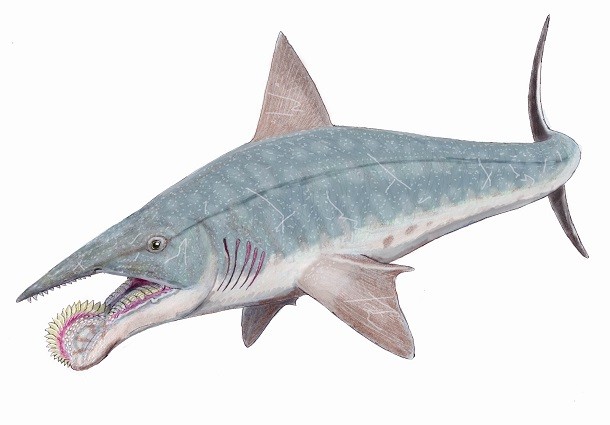
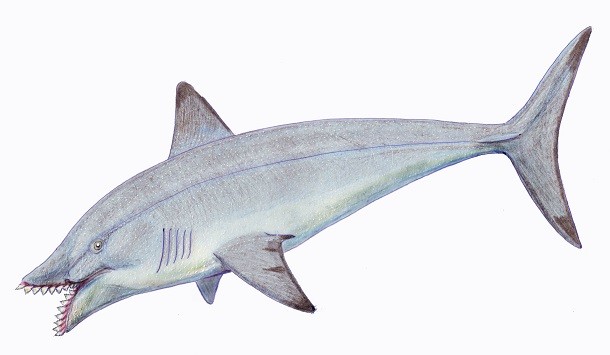
1. Helicoprion — The Buzzsaw Shark
Period: Permian | Size: Up to 25 feet (7.5 m) | Diet: Carnivore | Habitat: Oceans
Few prehistoric animals have inspired more confused scientific debate than Helicoprion. For over a century after its discovery, paleontologists couldn’t agree on where its most defining feature belonged: a spiraling whorl of dozens of serrated teeth that formed a perfect circular coil.
Was it on the snout? The dorsal fin? It wasn’t until modern CT scanning of fossils that researchers confirmed the tooth whorl sat inside the lower jaw, rotating like a biological buzzsaw as the animal bit down on prey. Helicoprion wasn’t even a true shark — it was a ratfish-like cartilaginous fish that could reach 25 feet long. Its spiral dental structure, which grew continuously throughout its life, remains one of the most structurally unique features ever found in a vertebrate.
—
2. Opabinia — The Five-Eyed Anomaly
Period: Cambrian | Size: ~3 inches (7 cm) | Diet: Scavenger/Predator | Habitat: Marine
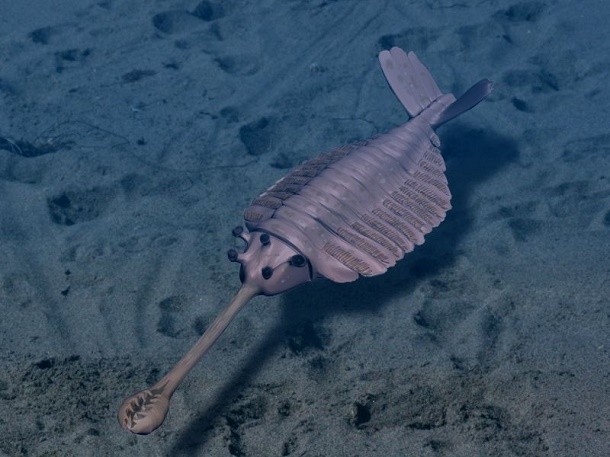
When paleontologist Harry Whittington presented his reconstruction of Opabinia to the Palaeontological Association in 1972, the audience reportedly burst out laughing. They weren’t being cruel — the animal genuinely looked like a joke.
Opabinia had five compound eyes arranged across the top of its head and a long, flexible proboscis extending from its front end, tipped with a claw that curved back toward its mouth. It used this remarkable appendage to snatch prey and deliver it to its circular, backward-facing mouth. No living animal phylum cleanly claims Opabinia as an ancestor — it represents a separate evolutionary experiment from the Cambrian period that left no descendants.
—
3. Hallucigenia — The Spiny Worm
Period: Cambrian | Size: 0.4–2 inches (1–5 cm) | Diet: Unknown | Habitat: Marine
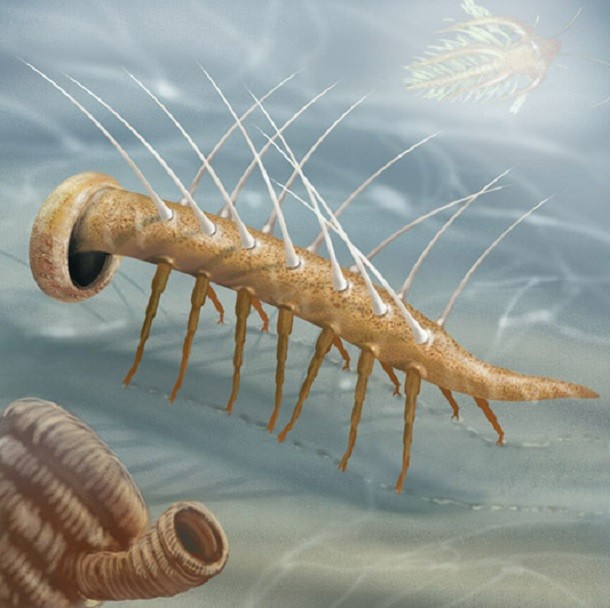
Its name tells you everything. When scientists first described Hallucigenia in 1977, they were so baffled by the fossil that they reconstructed it upside down and back to front — walking it on its dorsal spines and treating its tentacle-like legs as a fringe along its back.
Decades of subsequent study revealed that the spines were actually defensive armor on its back, while seven pairs of clawed limbs supported it from below. Hallucigenia belongs to the extinct group Hallucigeniidae, distantly related to modern velvet worms. At barely an inch long, it was among the most structurally perplexing animals of the Cambrian explosion, a period when evolution seemed to be testing every conceivable body plan simultaneously.
—
4. Arthropleura — The Giant Millipede
Period: Carboniferous | Size: Up to 8.5 feet (2.6 m) | Diet: Herbivore | Habitat: Forests
Picture a millipede. Now make it longer than a sofa and heavy enough to leave deep trackways in ancient rock. That’s Arthropleura, the largest known terrestrial invertebrate in Earth’s history.
This armored giant patrolled the dense coal forests of the Carboniferous period around 300 million years ago, when atmospheric oxygen levels were significantly higher than today — a factor many scientists believe enabled invertebrates to grow to extraordinary sizes. Arthropleura fed on plant matter, likely using its broad, segmented body to bulldoze through decaying vegetation. Its fossilized trackways, discovered in locations including Scotland and Nova Scotia, are among the most impressive trace fossils ever found.
—
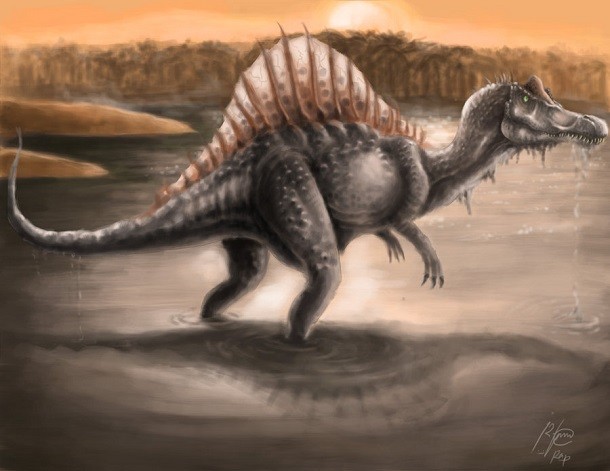
5. Deinocheirus — The “Horrible Hand” Dinosaur
Period: Late Cretaceous | Size: Up to 36 feet (11 m) long | Diet: Omnivore | Habitat: Swamps and rivers
When paleontologists first uncovered Deinocheirus in Mongolia’s Nemegt Formation in 1965, they found only a pair of arms — each over 8 feet long with three 8-inch claws. For nearly 50 years, those terrifying arms were all scientists had. They named it “horrible hand” and spent decades speculating about what creature could have carried them.
The full picture, finally revealed in 2014, was almost more surprising than anything imagined. Deinocheirus was a humped, duck-billed, sail-backed omnivore that ate fish, plants, and small animals. It weighed around 6 tons, carried those enormous arms on a body shaped like a bizarre mash-up of a camel and a hadrosaur, and had a skull filled with hundreds of small packing peanut-shaped vertebrae. Evolution had absolutely outdone itself.
—
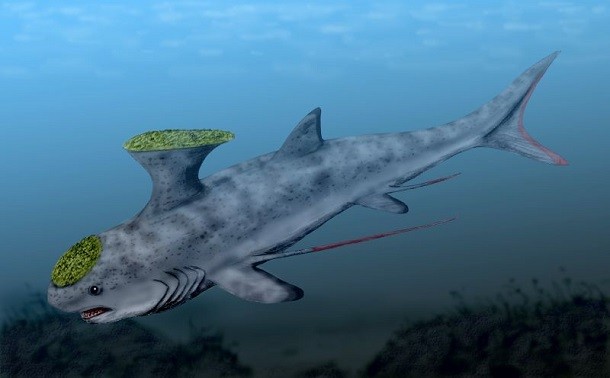
6. Stethacanthus — The Ironing Board Shark
Period: Late Devonian to Early Carboniferous | Size: ~2.3 feet (70 cm) | Diet: Carnivore | Habitat: Marine
Modern sharks have dorsal fins. Stethacanthus had what can only be described as an ironing board mounted on its back. Instead of a streamlined fin, this ancient shark carried a flat, anvil-shaped dorsal structure covered in small tooth-like denticles — and the same denticles covered a patch on top of its head.
The purpose of this extraordinary structure remains debated. Leading theories suggest it played a role in mating display or species recognition. Some researchers have proposed that the denticle-covered head and dorsal platform may have interlocked during courtship. Whatever its function, Stethacanthus proves that the basic “shark template” has been radically reimagined multiple times throughout evolutionary history.
—
7. Diplocaulus — The Boomerang-Headed Amphibian
Period: Late Carboniferous to Early Permian | Size: ~3 feet (1 m) | Diet: Carnivore | Habitat: Freshwater
Diplocaulus looked like someone attached a boomerang to the front of a salamander. Its broad, crescent-shaped skull extended dramatically to either side, producing “horns” that were actually extensions of its skull bones. The animal itself was relatively small — about 3 feet long — but that head was unmistakable.
Why evolve such an impractical-looking structure? Current thinking suggests the boomerang skull acted like a hydrofoil, helping Diplocaulus maintain position in river currents without constant muscle effort. The wide cranial extensions may also have made it extremely difficult for predators to swallow. It lived in the freshwater environments of what is now North America and Africa, hunting small fish and insects.
—
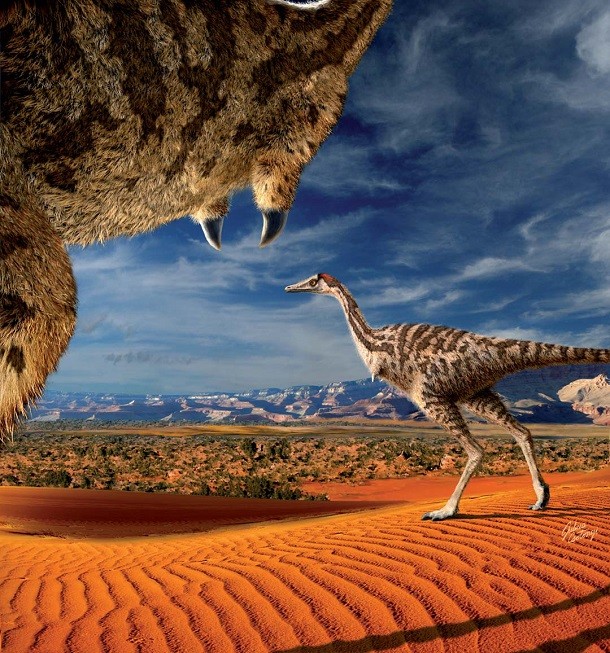
8. Longisquama insignis — The “Long Scale” Glider
Period: Middle Triassic | Size: ~6 inches (15 cm) | Diet: Insectivore | Habitat: Forests
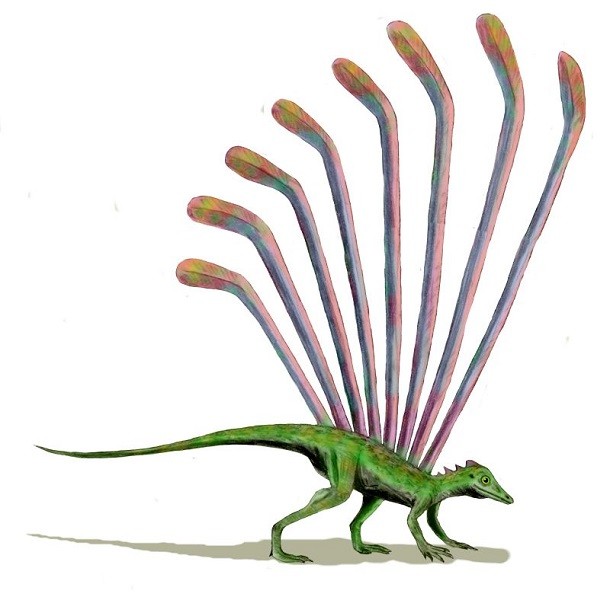
Longisquama is one of the most debated prehistoric animals in paleontology. This tiny Triassic reptile bore a dramatic row of elongated, feather-like appendages along its back — structures that some scientists initially proposed were precursors to bird feathers, sparking intense controversy.
The consensus today is that these appendages were modified scales rather than true feathers, but their function remains mysterious. The leading hypothesis is that Longisquama used them for gliding between trees, spreading them like a parachute to slow descent. Whatever their purpose, these dramatic dorsal structures — some nearly as long as the animal’s body — make Longisquama one of the most visually extraordinary reptiles of the Triassic, a period already packed with evolutionary experimentation.
—
9. Tanystropheus — The Long-Necked Reptile
Period: Middle Triassic | Size: Up to 20 feet (6 m) | Diet: Carnivore | Habitat: Coastal marine
Tanystropheus had a neck so long it almost defies functional credibility. Of its total body length of up to 20 feet, roughly half was neck — yet that extraordinary neck contained only 10 elongated vertebrae, each dramatically stretched in length.
Recent analysis published in 2020 revealed something even more surprising: the fossil record shows two distinct size classes of Tanystropheus that actually represent two different species, one land-dwelling and one aquatic. The larger aquatic form used its rigid, pole-like neck to ambush fish and cephalopods from the water’s surface, while the smaller land form hunted insects. It’s a reminder that a single bizarre fossil record can conceal even stranger stories within it.
—
10. Pterodaustro — The Filter-Feeding Pterosaur
Period: Early Cretaceous | Size: Wingspan up to 8 feet (2.5 m) | Diet: Filter-feeder | Habitat: Coastal lagoons
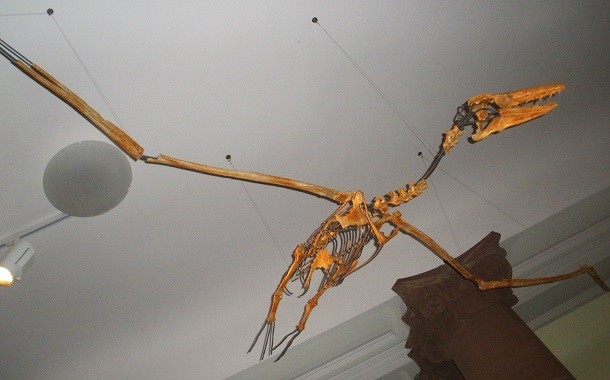
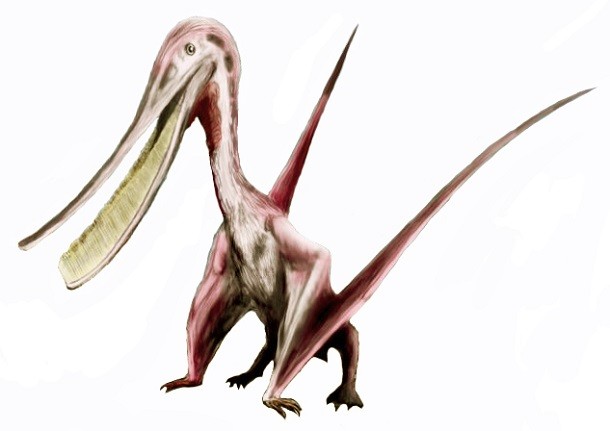
Most people imagine pterosaurs as swooping, fish-snatching fliers. Pterodaustro had a very different business model. Its curved lower jaw was packed with thousands of long, bristle-like teeth that functioned like a flamingo’s bill — filtering plankton, small crustaceans, and other tiny organisms from the water.
This feeding strategy has led some scientists to propose that, like modern flamingos, Pterodaustro may have had pinkish coloration due to carotenoids in its crustacean-heavy diet. With a wingspan of up to 8 feet and those extraordinary jaws, it would have been a dramatic sight wading through Cretaceous lagoons in what is now Argentina. It’s one of the most complete pterosaur specimens known, making it invaluable for understanding pterosaur diversity.
—
11. Anomalocaris — The Anomalous Shrimp
Period: Cambrian | Size: Up to 3.3 feet (1 m) | Diet: Predator | Habitat: Marine
The name means “abnormal shrimp,” which is both accurate and a spectacular understatement. Anomalocaris was the apex predator of the Cambrian seas — enormous by the standards of its time, when most animals measured in millimeters — equipped with large compound eyes containing up to 16,000 lenses each, two spiny grasping appendages in front of its mouth, and a circular, pineapple-slice-like mouth ringed with overlapping plates.
Its fossils were so fragmentary that early paleontologists assigned its different body parts to three separate animals: a shrimp, a jellyfish, and a sea cucumber. Only when a complete specimen emerged did the full, frightening picture come together. Anomalocaris was the blueprint for predatory dominance in early animal life.
—
12. Tullimonstrum — The Tully Monster
Period: Carboniferous | Size: ~14 inches (35 cm) | Diet: Unknown | Habitat: Shallow marine estuaries
Francis Tully discovered this bizarre animal in Illinois in 1955, and scientists have been arguing about it ever since. Tullimonstrum gregarium — the Tully Monster — had eyes mounted on rigid stalks extending from either side of its body, a long proboscis ending in a tiny jaw armed with teeth, and a body that resembles nothing in any known animal phylum.
The debate centers on a fundamental question: was it a vertebrate or an invertebrate? A 2016 paper argued it was a vertebrate, related to lampreys. Later studies pushed back, arguing its anatomy doesn’t support vertebrate classification. Illinois loved the Tully Monster enough to make it the state fossil in 1989, even as scientists still can’t agree on what kind of animal it was.
—
13. Yi qi — The Bat-Winged Dinosaur
Period: Middle to Late Jurassic | Size: ~1 foot (30 cm) | Diet: Insectivore | Habitat: Forests
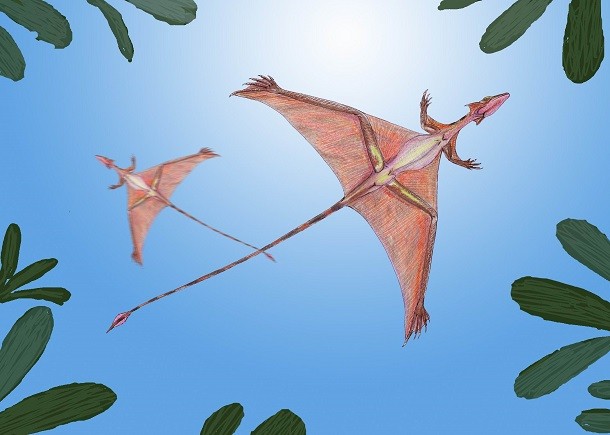
Yi qi (pronounced “ee chee”) means “strange wing” in Mandarin, and it earns every syllable of that name. This pigeon-sized dinosaur from China bore bat-like membranous wings supported by an elongated bony strut extending from its wrist — a structure seen nowhere else in dinosaur evolution.
Unlike bird-lineage dinosaurs, which developed feathered wings by modifying their arm bones, Yi qi essentially reinvented flight from scratch using a completely different architecture. It was almost certainly feathered across its body while its wings remained membrane-based. Whether it could truly fly or merely glided remains debated, but Yi qi represents a stunning example of convergent evolution — independently arriving at a bat-like solution to the challenge of aerial locomotion, millions of years before bats existed.
—
14. Epidexipteryx — The Display Dinosaur
Period: Middle to Late Jurassic | Size: ~10 inches (25 cm) | Diet: Insectivore | Habitat: Forests
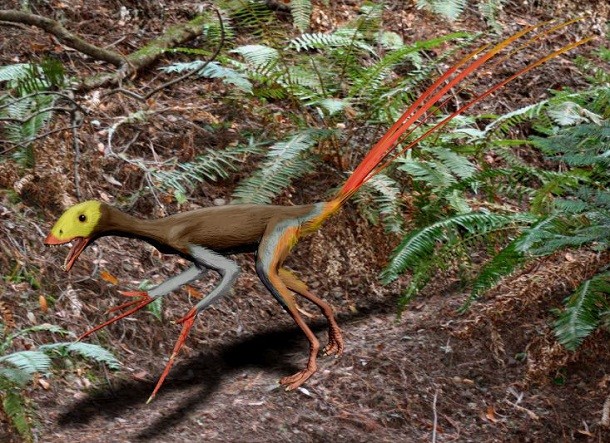
Another remarkable find from China’s Jurassic deposits, Epidexipteryx was roughly sparrow-sized and covered in body feathers — but its most dramatic feature was four extraordinarily long, ribbon-like tail feathers used purely for display.
This makes Epidexipteryx the earliest known non-avian dinosaur with ornamental feathers, pushing the origin of feather-based display behavior back into the Middle Jurassic. It had short arms, a rounded skull with forward-projecting teeth ideal for probing bark for insects, and those spectacular tail ribbons that it likely waved to attract mates or intimidate rivals. It’s a remarkable reminder that feathers evolved for display and insulation long before they were used for flight.
—
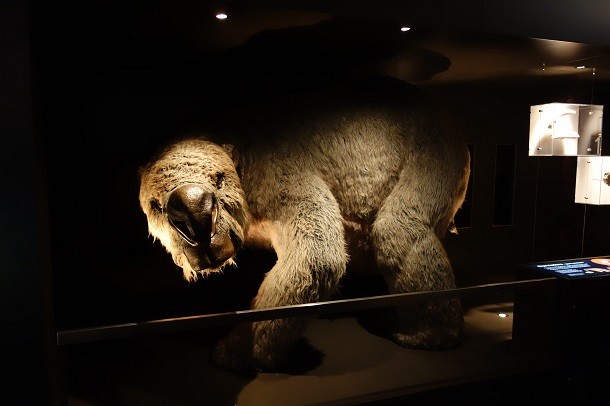
15. Chalicotherium — The Clawed Horse
Period: Oligocene to Pliocene | Size: Up to 8.5 feet (2.6 m) tall | Diet: Herbivore | Habitat: Forests
Chalicotherium looked like a horse that had taken a very wrong evolutionary turn. Its head was distinctly horse-like, its lineage was closely related to horses and rhinos — but instead of hooves, it had large, curved claws on its forelimbs, used to pull down tree branches for feeding.
It walked on its knuckles like a gorilla to protect those claws, moving in a slow, lumbering fashion through Eurasian forests. At up to 8.5 feet tall, it would have been a startling sight. Chalicotherium is a perfect example of how evolution frequently repurposes body plans in unexpected directions — taking the framework of a horse and producing something that looks more like a bear crossed with a ground sloth.
—
16. Cotylorhynchus — The Barrel-Bodied Synapsid
Period: Early Permian | Size: Up to 11 feet (3.5 m) | Diet: Herbivore | Habitat: Terrestrial
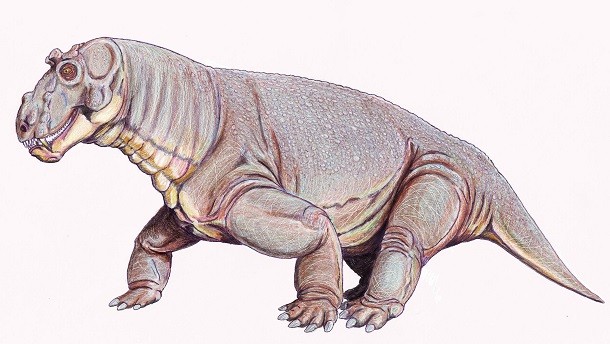
Cotylorhynchus had proportions that look almost deliberately comedic: a massive, barrel-shaped body supported by stout legs, all topped with a comically small head. It was one of the largest land vertebrates of its time, yet its skull was roughly the size of a modern dog’s.
As a synapsid — the group that would eventually give rise to mammals — Cotylorhynchus represents an early experiment in large-scale herbivory on land. Its enormous gut capacity likely allowed it to process huge quantities of low-quality plant material, similar to how modern large herbivores operate. The disproportion between body and head is so extreme that it remains one of the most visually striking silhouettes in all of paleontology.
—
17. Therizinosaurus — The Scythe Lizard
Period: Late Cretaceous | Size: Up to 33 feet (10 m) long | Diet: Herbivore | Habitat: Forests
Therizinosaurus possessed the longest claws of any known animal in Earth’s history — up to 20 inches (50 cm) each, curved like giant scythes. When the first fossils were discovered in Mongolia in 1954, scientists initially thought they’d found a giant turtle.
The full animal was a paradox: a pot-bellied, bipedal theropod dinosaur — the same group that includes T. rex — but a committed herbivore. Those apocalyptic claws weren’t for killing prey; they were used to drag tree branches within reach. Therizinosaurus was essentially the prehistoric equivalent of a giant sloth that happened to look like it could demolish a tank. It’s one of the most disorienting dinosaurs ever discovered, challenging assumptions about what a large theropod “should” do with its anatomy.
—
18. Shastasaurus — The Gentle Giant Ichthyosaur
Period: Middle to Late Triassic | Size: Up to 69 feet (21 m) | Diet: Suction feeder | Habitat: Marine
Shastasaurus holds the title of largest marine reptile ever discovered. At up to 69 feet long, it dwarfed most animals that have ever lived in the ocean. Yet despite its extraordinary size, it had virtually no teeth — just a small, tubular snout it used to suck soft-bodied cephalopods from the water like a biological vacuum cleaner.
This toothless suction-feeding strategy in an animal of such immense size has no clear parallel in the modern ocean. Modern suction feeders tend to be small; modern giants (like baleen whales) filter-feed differently. Shastasaurus carved out a completely unique ecological niche, demonstrating that enormous size doesn’t require enormous weaponry — sometimes the biggest animal in the room is also the most peaceful.
—
19. Platybelodon — The Shovel-Tusked Elephant
Period: Miocene | Size: Up to 10 feet (3 m) tall | Diet: Herbivore | Habitat: Swamps and wetlands
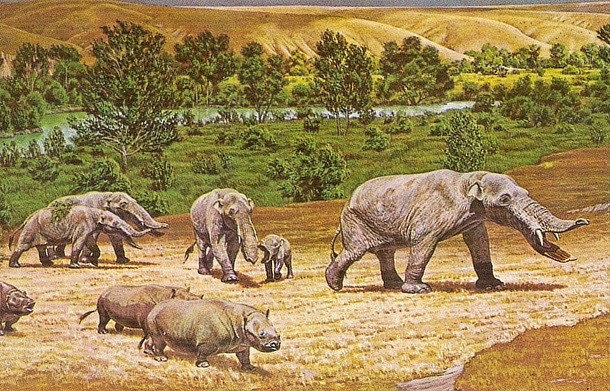
Platybelodon was a relative of modern elephants — but instead of graceful curved tusks, it sported two broad, flattened lower tusks that fused together into a giant biological shovel. For decades, scientists assumed it used this extraordinary dental equipment to scoop aquatic plants from swamp bottoms.
More recent analysis suggests the truth was stranger: Platybelodon may have used those flattened tusks as a bark-stripping tool, cutting vegetation with a slicing motion rather than scooping. It lived across Africa, Europe, and Asia during the Miocene, and its remains show significant variation in tusk shape, suggesting the “shovel tusk” design was itself evolving rapidly before the entire lineage died out.
—
20. Macrauchenia — The Long-Necked Llama With a Trunk
Period: Pliocene to Pleistocene | Size: ~10 feet (3 m) long | Diet: Herbivore | Habitat: Grasslands
Darwin collected Macrauchenia fossils during the voyage of the Beagle and was completely baffled by them. It had the body proportions of a camel, the three-toed feet of a rhino, a neck like a llama, and nasal openings positioned high on the skull — indicating it likely had a short trunk or highly flexible nose.
Macrauchenia belonged to an entirely separate mammalian radiation that evolved in South America during its long period of continental isolation. When North and South America reconnected around 3 million years ago, Macrauchenia had to compete with newly arrived northern mammals. It survived until roughly 10,000 years ago, possibly meeting early human hunters at the end. Its exact evolutionary relationships were debated for over 150 years, finally resolved by ancient DNA analysis in 2017.
—
21. Gigantopithecus — The Giant Ape
Period: Miocene to Pleistocene | Size: Up to 10 feet (3 m) tall, 600 lbs (270 kg) | Diet: Herbivore | Habitat: Forests
The largest primate known to science, Gigantopithecus blacki lived in the forests of what is now southern China and Southeast Asia, surviving until approximately 300,000 years ago. At up to 10 feet tall and potentially 600 pounds, it would have dwarfed any modern gorilla.
Despite its fearsome proportions, Gigantopithecus was likely a peaceful herbivore specializing in bamboo and forest fruits — essentially a gigantic, ancient relative of the orangutan. It co-existed with early members of our own genus. The fossil record consists almost entirely of teeth and jaw fragments, which means estimates of its full size carry some uncertainty. That scarcity of remains has also made it a recurring subject of cryptozoological speculation, with some enthusiasts linking it to Bigfoot legends.
—
22. Nuralagus rex — The Giant Sardinian Pika
Period: Pliocene to Pleistocene | Size: ~2 feet (60 cm) long, 33 lbs (15 kg) | Diet: Herbivore | Habitat: Island (Sardinia)
Island environments have a remarkable tendency to produce giants from small animals and dwarfs from large ones — a phenomenon called the island rule. Nuralagus rex, the “king of the rabbits,” was a product of this process gone to an extraordinary extreme on the ancient island of Sardinia.
A relative of pikas (small, rabbit-like mammals), Nuralagus grew to 33 pounds — about six times the size of a modern rabbit. But island gigantism came with trade-offs: its eyes were small, its ears were reduced, and its spine was so rigid it almost certainly couldn’t hop. It trundled slowly through Sardinian vegetation, safe from predators that didn’t exist on its island home, until sea level changes reconnected Sardinia with mainland Europe and introduced predators it had no experience avoiding.
—
23. Odontochelys semitestacea — The Half-Shelled Turtle
Period: Late Triassic | Size: ~16 inches (40 cm) | Diet: Omnivore | Habitat: Marine
Turtles are defined by their shells — it’s the most fundamental thing about them. So discovering a turtle ancestor with only half a shell was a genuinely landmark find. Odontochelys, discovered in China in 2008, had a fully developed plastron (the bottom plate) but only a partial carapace (the top shell) covering its backbone.
This fossil confirmed a long-debated hypothesis: that the turtle shell evolved from the bottom up, with the belly armor developing first as protection against aquatic predators attacking from below. It also retained teeth — something modern turtles completely lack — making it a crucial evolutionary missing link. Odontochelys lived around 220 million years ago and represents one of the clearest “caught in the act of evolving” fossils ever discovered.
—
24. Purgatorius — The Primate Ancestor
Period: Late Cretaceous to Paleocene | Size: ~6 inches (15 cm) | Diet: Omnivore | Habitat: Forests
Small, furry, and mouse-like, Purgatorius wouldn’t win any awards for dramatic appearance — but its significance to the story of life on Earth is enormous. It’s considered one of the earliest known primates or proto-primates, placing it at or very near the evolutionary root of the lineage that would eventually produce monkeys, apes, and humans.
Purgatorius lived in the trees of what is now North America, eating insects and fruit, and is remarkable for surviving the mass extinction event that killed the non-avian dinosaurs approximately 66 million years ago. Its teeth show early primate characteristics, including the complex molars suited to an omnivorous diet. Looking at this tiny creature — barely 6 inches long — and knowing it represents the beginning of your own evolutionary story is a genuinely humbling experience.
—
25. Diplocaulus (The Boomerang-Headed Amphibian) — Honorable Mention
We already featured Diplocaulus, so let’s close with the creature arguably most deserving of the final spot on any list of bizarre prehistoric animals.
25. Tanystropheus (Already covered) — Let’s complete with:
25. The Arthropleura’s Cousin: Attercopus fimbriunguis — Wait, let’s use the planned creature:
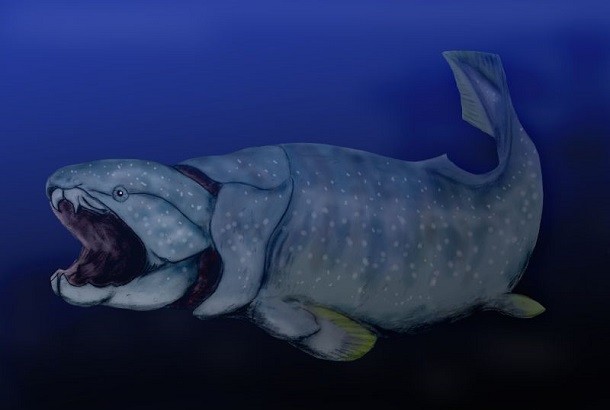
25. Dunkleosteus — The Armored Fish With No Teeth
Period: Late Devonian | Size: Up to 20 feet (6 m) | Diet: Carnivore | Habitat: Marine
Dunkleosteus terrelli was one of the most formidable predators of the ancient seas, but it achieved its terrifying bite without a single tooth. Instead, it had bony facial plates that self-sharpened as they slid against each other — essentially a set of biological bone-shears capable of generating a bite force estimated at 8,000 pounds per square inch.
This armored fish belonged to an extinct class called the placoderms, which dominated the world’s oceans during the Devonian period. Dunkleosteus could open its jaw in approximately 50 milliseconds, creating a powerful suction that drew prey directly into its mouth. The Devonian extinction wiped out the placoderms entirely, ending one of the most successful vertebrate experiments in history. The armored, self-sharpening, fang-free apex predator remains one of evolution’s most creative solutions to the challenge of being dangerous.
—
The End of an Era: Why These Wonders Disappeared
The creatures on this list vanished for many reasons — and understanding their disappearance is as fascinating as studying their existence. Mass extinction events played a decisive role for many: the Cambrian fauna was swept away by rapid ecological change, the end-Permian extinction killed perhaps 96% of all marine species, and the asteroid impact 66 million years ago ended the age of non-avian dinosaurs.
But extinction is rarely a single event. Many of these animals were already declining due to climate shifts, habitat changes, and competition from newly evolved rivals. Gigantopithecus may have been driven out by expanding grasslands that replaced its forest habitat. Macrauchenia likely met human hunters at the end of the Pleistocene. Evolution is relentless — the same process that produced these extraordinary creatures eventually replaced them with something new.
Every extinction, strange as it sounds, creates an opportunity. The disappearance of the non-avian dinosaurs opened ecological space that mammals rapidly filled, eventually leading to Purgatorius, then primates, then us. The bizarre creatures of Earth’s past aren’t just curiosities — they’re the stepping stones that led, through a million improbable turns, to the present world.
—
A Glimpse into Earth’s Imaginative Past
The 25 strangest prehistoric creatures on this list represent only a tiny fraction of the extraordinary animals that have walked, swum, and flown across this planet. Paleontologists are still finding new species at a remarkable rate — and with every new fossil, the picture of Earth’s past grows stranger and richer.
What these animals remind us is that the natural world has no fixed template. Evolution doesn’t trend toward any particular shape or strategy — it simply tests what works, abandons what doesn’t, and occasionally produces something so outlandish that scientists initially reconstruct it upside down. The Cambrian seas, the Carboniferous forests, the Jurassic skies, and the Pleistocene grasslands were all populated by creatures that would seem utterly alien if we encountered them today.
For fans of fascinating natural history content — the kind of deep dives and surprising facts that make you see the world differently — lists like this one are just the beginning. Earth’s prehistoric record is a cabinet of curiosities so vast and so strange that explorers and scientists have been cataloging it for centuries without running out of surprises.
—
Frequently Asked Questions
What is the strangest prehistoric creature ever discovered?
“Strangest” is subjective, but many paleontologists point to Opabinia or Hallucigenia from the Cambrian period as the most structurally bewildering animals ever found. Both were so confusing that initial reconstructions were completely wrong, and neither fits neatly into any modern animal group.
What was the largest prehistoric creature to ever live?
Among creatures on this list, Shastasaurus holds the record at up to 69 feet long. Overall, the blue whale — still alive today — may surpass most prehistoric giants in size, though the massive sauropod dinosaur Patagotitan mayorum gives it strong competition for the land-size title.
Did any of these strange prehistoric animals coexist with humans?
Several did. Gigantopithecus survived until roughly 300,000 years ago, overlapping with early Homo sapiens’ ancestors. Macrauchenia lived until approximately 10,000 years ago and likely encountered early human settlers in South America. Megalania, the giant monitor lizard, may have been encountered by the first Australians.
Why do so many prehistoric animals look so bizarre compared to modern ones?
Many Cambrian and early Paleozoic creatures represent evolutionary experiments that left no direct descendants — entire body plans that were tried and abandoned. Additionally, our familiarity with modern animals creates a baseline of “normal” against which ancient life looks strange. In reality, evolution has no aesthetic preferences.
How do scientists know what these creatures looked like?
Most knowledge comes from fossilized bones, teeth, and shells. Soft tissue rarely fossilizes, though exceptional preservation sites like the Burgess Shale in Canada and the Yixian Formation in China have produced fossils with skin, feathers, and even internal organ outlines preserved. CT scanning and chemical analysis now extract information from fossils that earlier generations of scientists couldn’t access.
Are there still unknown prehistoric creatures waiting to be discovered?
Absolutely. Paleontologists describe dozens of new species every year. Vast regions of Africa, South America, and Central Asia remain underexplored paleontologically, and new analytical techniques regularly reveal new species hidden within existing fossil collections. The history of life on Earth is far from fully written.